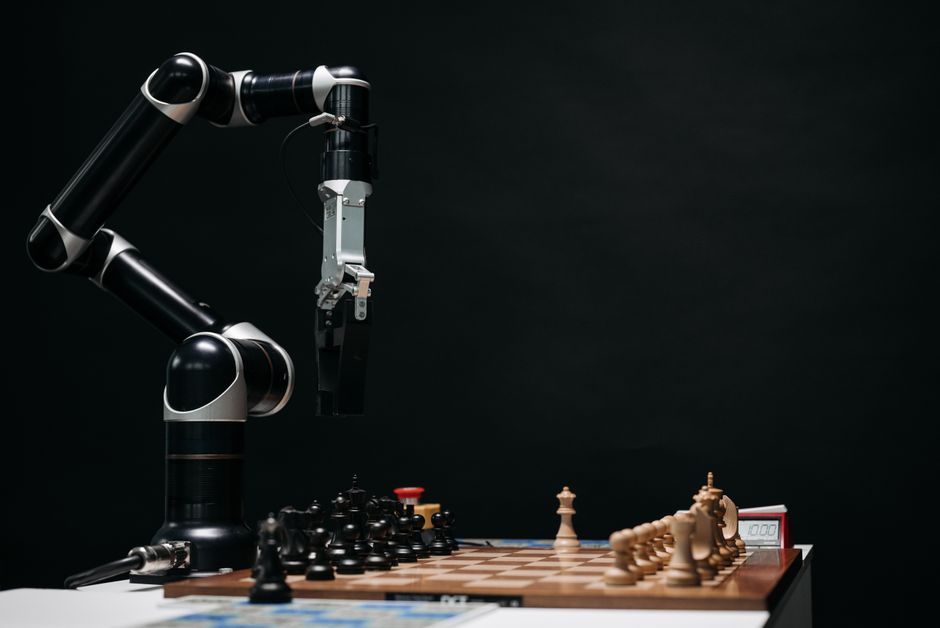
The recovery matters more when it shows the system can detect its own mistake, limit the consequence, and return control to a person. A successful routine proves the robot can perform under expected conditions; one visible error shows what happens when conditions stop cooperating.
At 3:17 on a Thursday afternoon in Berlin, Malik stood behind the second row of folding chairs with his phone held chest-high. He was an invented composite founder for this scenario, three months from his next funding decision and still unsure whether his warehouse automation product was ready for a customer trial.
On the demonstration table, a robotic arm had already moved six objects into the correct trays. Then it reached for a blue cylinder and closed its gripper around the red block beside it.
The room went quiet.
That single movement threatened the meeting Malik had scheduled for Monday. If the robot dropped the wrong component into a customer’s packing flow, his trial could be postponed. His small team had already spent weeks preparing the integration. Another delay would consume time they had reserved for finding the next customer.
The arm lifted the block.
Then it stopped.
The pause revealed more than the successful picks
The robot did not continue the sequence as though nothing had happened. It lowered the block back onto the table, opened its gripper, moved away, and waited for an operator.
Malik stopped recording.
The first six picks now mattered less to him. They showed competence inside the routine. The seventh showed whether the system could recognize uncertainty before uncertainty became damage.
That distinction appears in every AI product I have shipped or reviewed. A clean demo tells me the intended path works. A failed action followed by a controlled response tells me whether the team has designed for the paths they cannot predict.
I would want to know what caused the stop. Did the vision model produce a confidence score below a threshold? Did a second check catch a mismatch between the requested object and the gripped object? Did the operator interrupt manually?
Each answer points to a different level of readiness. A planned stop can be evidence of sound product judgment. A lucky stop proves very little.
Recovery has to be designed before the demo
Founders often spend the week before a public demonstration improving the visible routine. They adjust lighting, choose objects the model recognizes reliably, and rehearse the sequence until the arm behaves.
That work is reasonable. The danger begins when rehearsal hides the questions a customer will face on an ordinary Monday.
What happens when two objects overlap? What does the system do when its confidence falls? Can an operator see why it stopped? Can the task resume from the failed step, or must the whole sequence restart? Which actions require human approval?
These are product decisions, not edge-case housekeeping.
The same principle applies outside robotics. An automated contract workflow may route nine agreements correctly, then misread the authority attached to the tenth. The important evidence is whether it proceeds silently or pauses before committing the company. That is the central tension in what a changed liability clause taught Kweku about authority.
A system earns trust through bounded behavior. It should know which actions it may take, what evidence it needs, and when a person must decide.
A good recovery produces evidence
After the demonstration, Malik waited while the operator opened the event log. The display showed the requested object, the detected object, the confidence attached to each classification, and the rule that had stopped the motion.
Now he had something he could discuss with his team.
The mistake had become a test case. They could reproduce it with similar shapes, change the object positions, vary the lighting, and check whether the same control held. They could also decide what the customer should see when the robot paused.
Without that record, “the robot recovered” would remain a reassuring story. With it, the team could inspect the chain of events and decide whether Monday’s trial still made sense.
This is where product readiness separates from demo readiness. A demonstration is arranged to show a capability. A product must also expose enough information to diagnose failure, assign responsibility, and choose the next action.
I have seen the same gap when software produces technically valid output that fails in the physical process that follows. Valid CAD geometry can still be impossible to manufacture. The output alone does not settle the question. The surrounding checks determine whether the system belongs in a working operation.
Monday should test the boundary
Malik kept the Monday meeting, but changed what he planned to demonstrate.
He would still run the normal sequence. Then he would deliberately move the blue cylinder close to the red block and ask the robot to pick it. If the arm selected correctly, good. If it became uncertain, the customer would see the pause, the reason, and the operator’s next step.
That made the trial harder. It also made the conversation more useful.
A founder watching a public manipulation demo should resist scoring the robot by completed motions alone. Watch the wrong reach. Note when the system detects it, what remains reversible, what evidence appears, and who receives control.
At 9:00 on Monday, Malik’s first test would begin with the objects slightly out of place.
Comments
No comments yet.